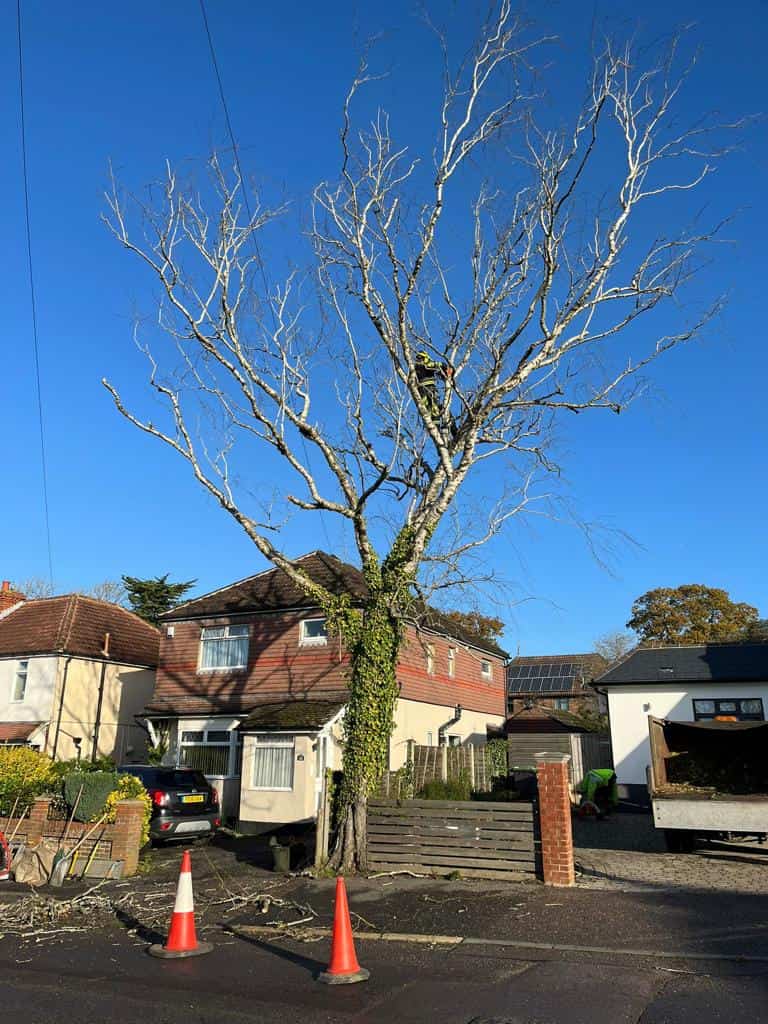
Removing a tree does not automatically remove everything associated with it. Once the trunk and crown have been taken down, the stump and much of the root system normally remain below ground. Although leaving the stump may initially seem harmless, it can become an awkward feature that restricts how the surrounding garden is used and makes future landscaping more difficult.
For property owners in Witley, Surrey, stump grinding provides a practical way to deal with the remaining base of a felled tree without excavating the entire root network. A stump grinder reduces the accessible stump to material below the surrounding surface level, allowing the area to be managed, reinstated or incorporated into future garden plans more easily. Whether grinding is worthwhile depends on the stump’s position, size and what you intend to do with the space afterwards.
What Are the Benefits of Grinding Out a Tree Stump?
Stump grinding is primarily about making the area left after tree removal more practical. A stump can remain solid for a considerable period, occupying usable ground and interfering with mowing, planting, paths and general garden maintenance.
Grinding does not normally mean excavating every root extending through the soil. Instead, the main stump and relevant accessible root material are mechanically reduced to an appropriate depth. This is often sufficient where the objective is to remove the obvious obstruction and prepare the area for sensible future use.
Tree Felling and Stump Removal Are Separate Jobs
When a tree is felled, the trunk is normally cut down close to ground level.
The stump does not disappear with the rest of the tree.
Its base and roots can remain firmly established within the ground long afterwards.
If the space needs to be reclaimed, stump grinding can therefore be considered as a separate stage following tree removal.
A Tree Stump Can Remain for Years
Natural decomposition is usually a gradual process.
A substantial stump can remain recognisable and physically solid for a long period after the tree has been removed.
Waiting for nature to remove it may therefore leave an inconvenient obstruction in the garden for considerably longer than expected.
Grinding provides a more direct way to deal with the remaining stump.
Stumps Can Take Up Useful Garden Space
The amount of space occupied by one stump may appear relatively small.
Its practical impact can be greater than its dimensions suggest.
The surrounding ground can become difficult to use because planting, mowing or landscaping needs to work around the obstruction.
Removing the stump can make the complete area more usable rather than simply recovering the exact footprint of the trunk.
Stump Grinding Can Help Reclaim the Area
Once the main stump has been reduced below the required level, the space can be prepared according to its future purpose.
For some gardens, the objective may simply be to create a cleaner, more manageable area.
Others may eventually incorporate the ground into a lawn, border or wider landscaping project.
Discussing the intended use beforehand helps determine an appropriate grinding approach.
Stumps Can Interfere With Lawn Maintenance
A stump within a lawn creates an obstacle that needs to be repeatedly avoided.
Grass can grow around its perimeter, leaving awkward edges that are more difficult to maintain.
Surface roots may create additional interruptions.
Grinding the stump can make it easier to create a more continuous area for future lawn maintenance.
Low Stumps Can Be Surprisingly Difficult to See
A freshly cut stump may initially be obvious.
As grass and surrounding vegetation develop, a low stump can become less noticeable.
Its position may be familiar to regular garden users but less apparent to someone who does not know it is there.
Removing the physical obstruction can provide a cleaner and more predictable ground surface.
Surface Roots Can Create Additional Obstacles
The stump is not always the only visible remnant of the tree.
Larger roots can sometimes extend above or close to the surrounding ground level.
These can interfere with mowing and landscaping beyond the immediate stump.
Where relevant and accessible, certain prominent roots may also be addressed as part of stump grinding, depending on the intended result.
Stump Grinding Does Not Remove the Entire Root Network
This distinction is important.
Tree roots can extend considerably beyond the stump itself, and stump grinding is not the same as excavating every root from the soil.
The grinder concentrates on the stump and accessible root material that needs to be reduced.
Remaining underground roots generally stay in place and gradually break down over time.
Complete Root Excavation Is Often Unnecessary
For many gardens, removing every root would involve considerably more ground disturbance than is needed to achieve the desired result.
If the objective is to eliminate the visible stump and reclaim the immediate area, stump grinding can provide a more focused approach.
The amount of root material requiring attention depends on what will happen to the site afterwards.
Stumps Can Restrict Future Landscaping
A remaining stump can become particularly inconvenient when garden improvements are planned.
A new layout may need to be designed around it even when that is not the preferred arrangement.
Removing the stump before landscaping begins provides greater freedom when deciding how the area should be used.
This can make the garden design respond to the property rather than to an unwanted remnant of a previous tree.
Stump Grinding Can Be Useful Before Creating a New Lawn
Where the former tree position is intended to become part of a lawn, leaving a raised stump clearly interferes with the desired finish.
Grinding can reduce the obstruction before reinstatement work begins.
Further ground preparation may still be required afterwards because grinding alone does not automatically create a finished lawn.
The area needs to be considered according to its final use.
Ground Levels Need Attention After Grinding
Removing a stump changes the condition of the immediate area.
The resulting space contains ground stump material and may settle differently as remaining organic material changes over time.
This should be considered when reinstating the area.
Stump grinding is therefore an important preparation stage rather than necessarily the final step in landscaping.
Stump Grindings Need to Be Managed Appropriately
Grinding produces a mixture of fine woody material and surrounding material.
The amount generated depends on the size of the stump and how extensively it is ground.
What happens to this material should be considered alongside the intended use of the area.
A site being prepared for further landscaping may require a different finish from one where the objective is simply to remove the obvious obstruction.
Stumps Can Interfere With Garden Paths
A stump positioned close to an existing or proposed path can restrict how the route is arranged.
Surface roots may also influence the surrounding ground.
Grinding the stump can provide more flexibility when preparing the area.
The requirements should be discussed before work begins so that the necessary grinding depth can reflect the proposed layout.
Stumps Can Affect Garden Borders
A stump within a planting area can occupy space that might otherwise be used more effectively.
Its root structure can also influence how the immediate ground can be worked.
Grinding can remove the main obstruction and provide greater flexibility when reorganising the border.
Further preparation may still be required depending on the type of planting planned.
New Planting Needs Appropriate Preparation
Removing a stump does not automatically mean that another substantial plant or tree can simply be placed in exactly the same position without further consideration.
Remaining roots and the condition of the soil can influence future planting.
If replanting is planned, this should be discussed before grinding.
The future use of the site can then influence how the work is approached.
Stump Position Can Matter More Than Stump Size
A relatively small stump in the middle of a frequently used lawn can be more inconvenient than a much larger stump in an unused corner.
The decision to grind should therefore not be based solely on diameter.
Location, access and intended garden use are equally important.
A condition-led assessment helps determine whether removal would provide a meaningful practical benefit.
Stumps Near Frequently Used Areas Can Be Particularly Awkward
A stump positioned beside a garden route, seating area or other regularly used space can affect movement around the garden.
People may continually need to navigate around it.
Removing the obstruction can help the surrounding area function more naturally.
This is often one of the strongest practical reasons for arranging stump grinding after tree removal.
Several Stumps Can Fragment a Garden
The effect becomes more noticeable where multiple trees have previously been removed.
Several stumps spread across a lawn or garden can divide otherwise usable ground into awkward sections.
Each one creates an additional obstacle for mowing, landscaping and general movement.
Grinding several stumps can help turn these disconnected areas back into a more coherent garden space.
Old Stumps Can Become Partly Hidden by Vegetation
As surrounding plants develop, an old stump may become covered by grass or low vegetation.
Although this can make it less visually prominent, the physical obstruction remains.
The stump can still interfere with garden work even when it is difficult to see.
Grinding addresses the obstruction rather than simply disguising it.
A Stump Can Make a Garden Look Unfinished
After a large tree has been removed, the remaining stump can make the work feel incomplete.
This is particularly noticeable where the tree previously occupied a prominent position.
Grinding can create a cleaner transition between tree removal and the next use of the area.
The benefit is both practical and visual without requiring unnecessary disturbance across the wider garden.
Some Stumps Can Produce New Shoots
Depending on the tree, new growth can sometimes emerge from the stump or remaining root system after the main tree has been removed.
Repeatedly cutting these shoots addresses the visible regrowth without removing the stump itself.
Where ongoing regrowth is undesirable, stump grinding may form part of a more effective management approach.
The response varies between tree species, so individual assessment remains important.
Repeatedly Cutting Regrowth Does Not Remove the Obstruction
Even where new shoots are regularly removed, the physical stump remains.
The garden still needs to be maintained around it.
If the real objective is to reclaim the ground, continuing to cut shoots does not solve the practical problem.
Grinding deals with the stump itself rather than only the growth appearing above it.
Decaying Stumps Can Change Shape Over Time
A stump does not remain in exactly the same condition indefinitely.
As decomposition progresses, parts can soften, break down or become uneven.
This does not necessarily make the area easier to manage.
Instead, the garden may contain an irregular remnant that is still difficult to incorporate into the surrounding surface.
Natural Decay Is Not a Predictable Landscaping Method
Leaving a stump to decompose can eventually reduce it, but the process does not necessarily occur at a convenient rate or in a useful shape.
Some parts may break down while others remain solid.
For a garden where the space is required for a particular purpose, waiting for natural decay provides little control over when the ground becomes usable.
Stump grinding offers a more planned approach.
Removing the Stump Can Simplify Garden Redesign
Garden layouts often change after a mature tree has been removed.
The additional light and open space can create opportunities for new planting, lawns or other features.
A remaining stump can limit those options.
Grinding it out gives the new layout greater freedom to respond to the available space.
Stump Grinding Can Improve Access for Garden Work
A stump can obstruct equipment and make it difficult to work efficiently around the surrounding area.
This becomes particularly relevant before broader garden improvements.
Removing the main obstruction can simplify access for subsequent preparation.
Planning stump grinding before other landscaping work can therefore be more practical than returning to remove it afterwards.
It Can Be Sensible to Grind Before Major Garden Changes
If the stump is likely to be removed eventually, dealing with it before surrounding areas are completed can avoid unnecessary disruption later.
New lawns, planting and other improvements are easier to plan when the position of the stump has already been resolved.
This does not mean every stump must be removed immediately.
It means the future garden plan should guide the timing.
Not Every Stump Needs Immediate Removal
There are situations where a stump is located in an unobtrusive area and causes no meaningful difficulty.
If there are no plans to use the ground differently, leaving it temporarily may be reasonable.
Professional tree work should respond to an actual need rather than recommending grinding automatically after every tree is felled.
The practical question is whether the stump interferes with how the garden needs to function.
A Decorative Stump Can Sometimes Be Intentionally Retained
Some property owners deliberately incorporate a stump into a garden design.
Where this is genuinely desired and the position is suitable, removal may not be necessary.
This is different from leaving a stump simply because no decision has been made.
Understanding the long-term intention for the area helps determine whether grinding provides worthwhile benefits.
Stump Size Influences the Work Required
Tree stumps vary considerably in diameter and shape.
A small stump presents a different grinding task from the base of a large mature tree.
Large buttress roots can also increase the area requiring attention.
Assessing the stump beforehand helps determine the practical approach and the extent of grinding needed.
The Original Tree Can Influence Stump Structure
Different trees develop different root and stump forms.
Some produce broad bases or prominent surface roots, while others have a more compact visible stump.
This affects how the grinder needs to work around the area.
Stump grinding should therefore be planned around the individual tree remains rather than approached identically in every garden.
Access Is an Important Part of Stump Grinding
A stump grinder needs to reach the work area.
Garden gates, narrow passages, steps and surrounding features can all influence access.
This should be assessed before work begins.
Understanding the route to the stump helps ensure that the appropriate approach can be planned for the particular garden.
Nearby Features Need to Be Considered
Stumps are not always located in open lawns.
They may be close to fences, paths, planting or other established garden features.
The surrounding area needs to be considered when planning grinding.
A professional assessment helps determine what can be achieved while limiting unnecessary disturbance to areas that do not require work.
Grinding Depth Depends on the Intended Result
There is no single useful grinding depth for every stump.
The appropriate depth depends partly on what the area will become afterwards.
Removing an obstruction from a general garden area can require a different approach from preparing ground for a more specific landscaping project.
Discussing future plans before the work begins helps avoid grinding either more or less than is actually useful.
Stump Grinding Is More Focused Than Excavation
Mechanical grinding removes the main stump by progressively reducing the wood rather than digging out the complete root system.
This allows the work to concentrate on the area that needs attention.
For many gardens, this can be a practical way to reclaim the space without unnecessarily disturbing a much larger section of ground.
The exact suitability still depends on the individual site.
Stump Grinding Does Not Instantly Restore the Ground
Once the stump has been ground, the area may require further work depending on the desired finish.
Material may need to be managed, levels adjusted and the ground prepared for its next use.
This is particularly important where a lawn or carefully finished landscaped area is planned.
Understanding this beforehand creates more realistic expectations about the process.
Remaining Roots Will Change Gradually
Roots that are not removed during grinding remain within the ground.
Over time, they naturally break down.
This can lead to gradual changes within the soil as decomposition continues.
Future landscaping should take account of this rather than assuming that grinding makes every trace of the former root system disappear immediately.
Grinding Can Help Create a More Manageable Garden
The strongest argument for stump grinding is often straightforward practicality.
Removing an awkward stump can make mowing easier, open up landscaping options and reduce the number of obstacles within the garden.
For a stump that serves no useful purpose, reclaiming the area can provide a noticeable improvement in how the garden functions.
Stump Grinding Can Complete a Tree Removal Project
Where the intention behind tree felling was to clear a particular area, leaving the stump can mean that objective has only been partially achieved.
Grinding can complete the practical part of the removal by addressing the remaining obstruction.
This is especially relevant where the area is intended for immediate reuse.
The work should still be planned according to what will happen to the ground afterwards.
When Is Stump Grinding Particularly Worth Considering?
Grinding may be particularly useful where:
- the stump is positioned within a lawn;
- surface roots interfere with mowing or garden maintenance;
- the area is needed for future landscaping;
- the stump obstructs a path or frequently used garden route;
- several old stumps are fragmenting usable space;
- the remaining stump produces unwanted regrowth;
- vegetation is beginning to conceal a low stump;
- the garden layout is being redesigned;
- the stump occupies a prominent position;
- the ground needs to be reclaimed following tree felling.
These circumstances do not mean grinding is automatically required. They indicate situations where removing the stump can provide a clear practical benefit.
The Best Time to Consider Grinding Is Before Reinstatement
If a tree has recently been removed and the area will be landscaped, it makes sense to decide what should happen to the stump before completing surrounding work.
This allows the stump grinding and subsequent ground preparation to form part of the same overall plan.
Leaving the decision until after new garden features have been established can make access and reinstatement more complicated.
Why Professional Stump Grinding Matters
Stump grinding involves powerful machinery working around a substantial piece of embedded timber.
The stump’s size, root form, location and surrounding features all need to be considered.
Professional stump grinding allows the work to be planned according to the actual site and the result required.
It also allows the grinding depth and treatment of accessible surface roots to be discussed in relation to future garden use rather than simply reducing the visible top of the stump.
Professional Stump Grinding in Witley, Surrey
At NS Tree Surgery Witley, we understand that removing a tree often leaves property owners with a second decision: what to do with the stump.
Where the stump is causing no practical difficulty, immediate removal may not always be necessary. Where it occupies useful garden space, interferes with maintenance or restricts future landscaping, stump grinding can provide a focused way to deal with the remaining obstruction.
For gardens in Witley, Surrey, we can assess the stump, surrounding area and intended future use of the ground before recommending an appropriate stump grinding approach.
Conclusion
Tree stumps are often worth grinding out because leaving them in place can restrict how a garden is used long after the original tree has been removed. Stumps can interfere with mowing, occupy useful space, complicate landscaping, obstruct paths and remain present for many years while natural decomposition takes place.
Stump grinding provides a practical alternative to excavating the complete root system. By reducing the main stump and relevant accessible root material below the required level, the area can be prepared more easily for future garden use. Remaining underground roots can then break down gradually without the main stump continuing to dominate the space.
However, not every stump needs immediate removal. If it is positioned in an unused part of the garden and does not interfere with future plans, leaving it may be reasonable. The decision should depend on location, condition and what you want to achieve with the surrounding ground.
If you have a tree stump affecting the use of your garden in Witley, Surrey, contact NS Tree Surgery Witley. We can assess its size, position and surrounding area and recommend an appropriate stump grinding approach based on how you intend to use the space afterwards.
Call us on: 01483 967 989
Click here to find out more about NS Tree Surgery Witley
Click here to complete our contact form and see how we can help with your tree needs.